Mutawir - Construction Project Supervision Platform
Project register, six contract parties per project, contractor and consultant teams, Hijri milestones, per-item execution progress, monthly reports, 21 permissions and a JWT REST API for private-plan developers in Saudi Arabia
A developer of private residential plans in Riyadh supervises dozens of projects at once, each with a different owner, design consultant, supervising consultant, contractor and municipality engineer.
Progress lived in the contractor's weekly WhatsApp message and a monthly PDF nobody could search.
Management could not say which projects were behind plan, because the only number anyone tracked was a single overall percentage that hid the item that had not started.
Contract dates were Hijri on paper and Gregorian in Excel, so handover deadlines were routinely miscalculated.
Site engineers, quality engineers and supervisors were assigned by phone and forgotten when they moved projects.
Reports were emailed, renamed and lost.
Nobody could prove who changed a completion figure or when.
The company needed one Arabic system that held every project, every party and every percentage, with a history behind each change, and an API so field teams could feed it from their phones.
Project screenshots
Dashboard: project totals, status distribution and monthly analysis
We built Mutawir on ASP.NET Core 8 as an Arabic MVC web application with 33 Razor views and a companion REST API of 5 controllers and 16 endpoints secured with JWT and refresh tokens.
Every project carries its six parties, owner, consultant, designer consultant, supervisor consultant, contractor and secretariat engineer, alongside price, type, status, duration, site handover date, primary and final handover dates and a Google Maps location.
Dates are entered and displayed in the Umm al-Qura Hijri calendar and stored in Gregorian.
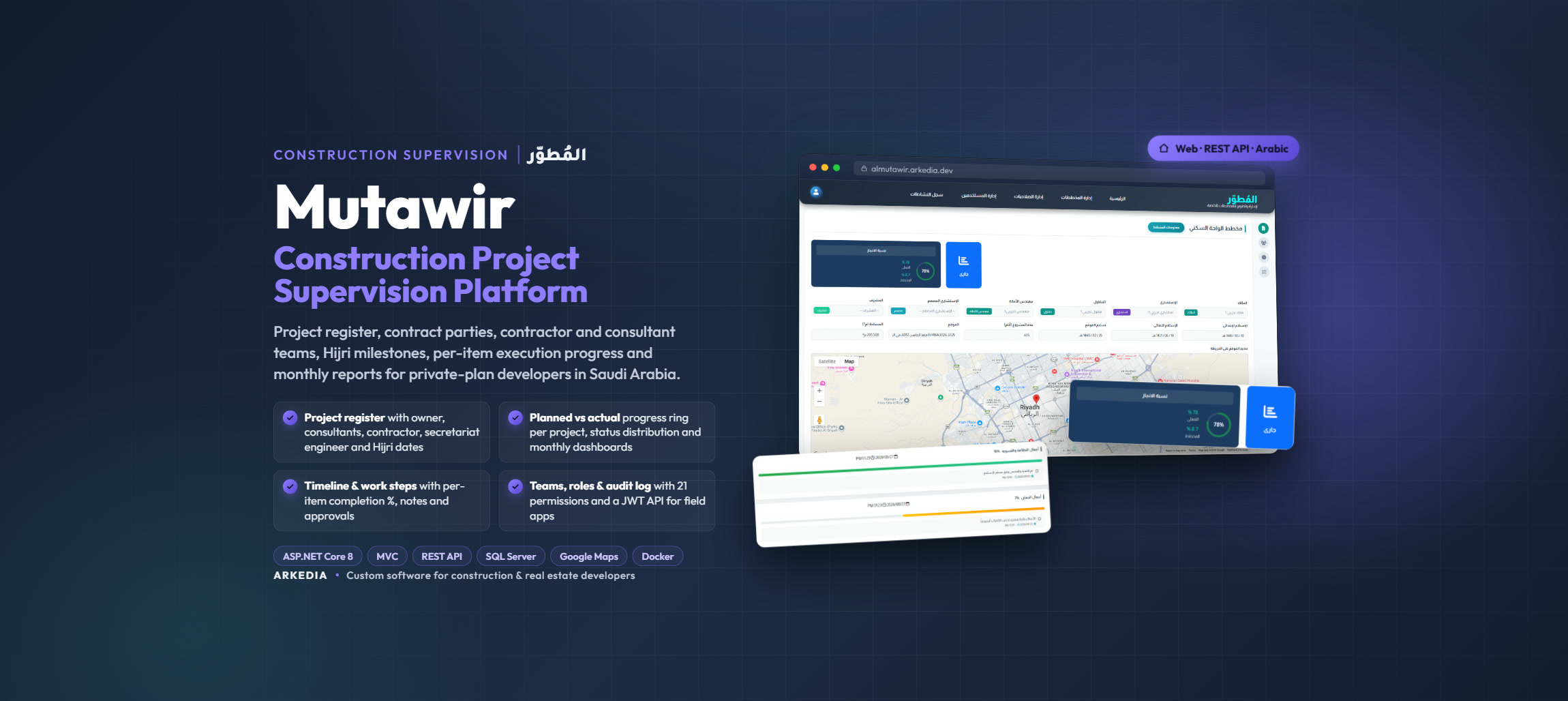
The project page shows planned versus actual completion in a progress ring, and the timeline tab breaks the project into milestones such as consultant selection, design approval, site handover and execution, each with a completion percentage, approval notes and detailed work steps that carry their own percentage, date and note.
The team tab organises the developer's own staff, the contractor's team and the consultant's team by job title.
Periodic reports with PDF attachments and project documents are stored per project.
Dashboards summarise total, ongoing, completed and delayed projects with a status distribution and a monthly analysis of active projects.
Access is controlled by 21 permissions in five groups, projects, reports, users, roles and audit logs, and every change is written to an exportable audit log.
The demo environment ships with 24 fully populated projects.
Results
20 domain entities, 33 Razor views and a JWT-secured REST API with 5 controllers and 16 endpoints for field apps
Six contract parties per project: owner, consultant, designer consultant, supervisor consultant, contractor and secretariat engineer
Planned versus actual completion per project with a progress ring and per-item work-step percentages
Milestone timeline covering consultant selection, design approval, site handover and execution, each with approvals, dates and notes
Umm al-Qura Hijri calendar for all contract dates, stored in Gregorian for calculation
Teams by job title for the developer, the contractor and the consultant, assigned per project
Periodic PDF reports and project documents attached to each project with download tracking
Dashboard with total, ongoing, completed and delayed projects, status distribution and monthly activity analysis
Google Maps location with coordinates on every project
21 permissions across projects, reports, users, roles and audit logs, with an exportable audit trail
Demo environment with 24 fully populated projects, teams, timelines, work steps and reports
Technology Stack
Want to help build the next one? See open engineering, design, and sales roles →