Project Pavilion - AI-Powered Project Management SaaS
Enterprise project management with AI co-pilot, risk detection, and stakeholder governance
Enterprise project managers juggle 5 disconnected tools.
Requirements live in Word docs.
Tasks sit in spreadsheets.
Risks get tracked in someone's head.
Stakeholder communication happens in email threads nobody reads.
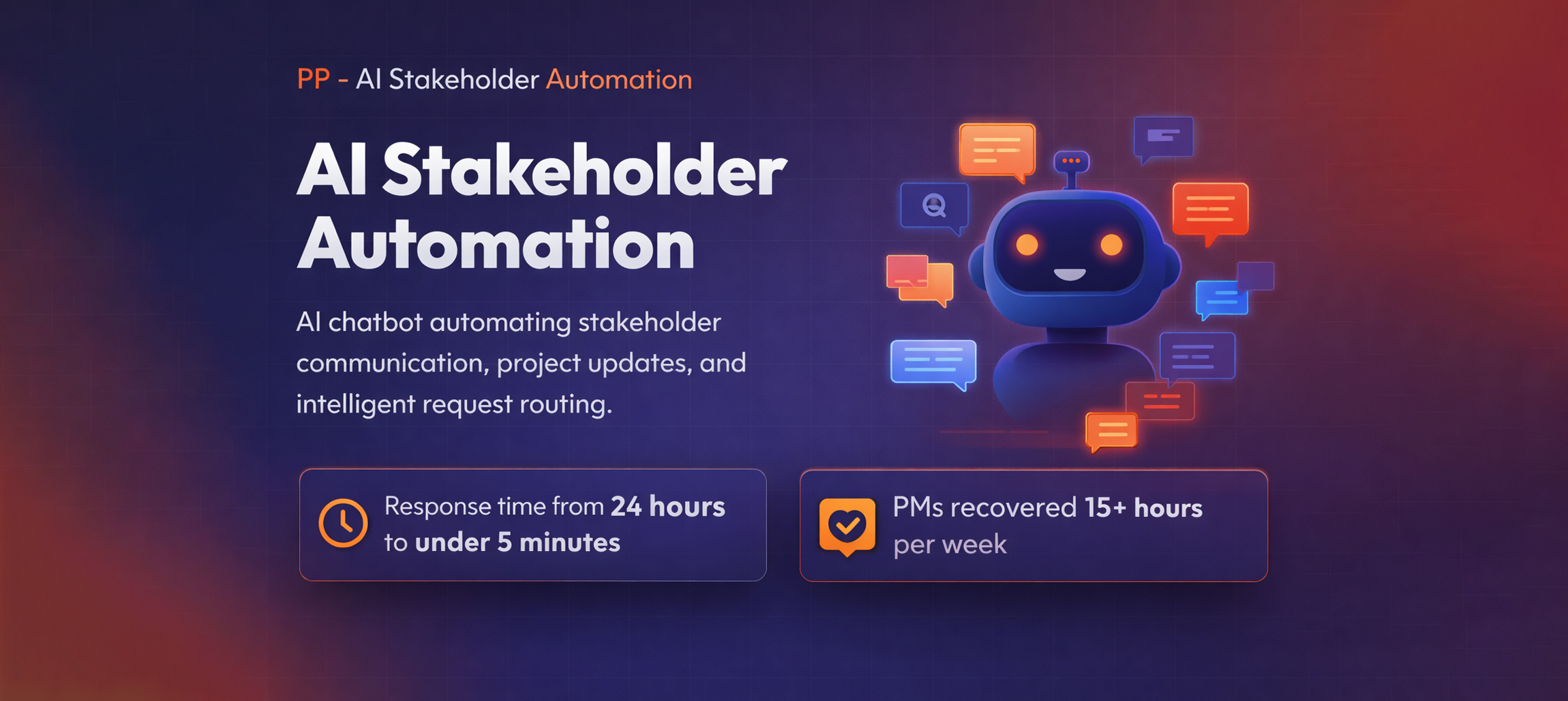
When a blocker appears, it takes 24 hours for the right person to find out.
Traceability audits take weeks because nobody linked requirements to deliverables.
The result: projects run 30% over budget and executives only learn about problems when it's too late to fix them.
Project screenshots
Projects with team size, requirements and task counts
We built one platform that replaces the disconnected toolchain.
An AI co-pilot powered by GPT-4.1 with RAG reads uploaded documents and creates project structures from them.
It answers stakeholder questions using real project context stored in Qdrant vectors.
Every AI action goes through a governance approval workflow before execution.
The platform includes 9 integrated modules: project management with Kanban boards, requirements tracking, risk management with probability-impact matrices, stakeholder governance with engagement scoring, meeting management with action items, traceability matrix linking requirements to tasks, team management with workspace isolation, subscription billing through Stripe, and a knowledge base that captures institutional memory via RAG.
Results
54 database entities with 148 CQRS commands and 85 queries powering 9 integrated modules
115 granular permissions across 15 categories with role-based workspace isolation
AI co-pilot with GPT-4.1, RAG over Qdrant vectors, streaming responses, and governance approval workflows
Document processing pipeline: upload PDF, Excel, or Word files and AI extracts project structure automatically
Risk management module with probability-impact scoring, mitigation strategies, and escalation workflows
Traceability matrix linking requirements to tasks, tests, and sign-offs for compliance audits
Stakeholder governance with power-interest mapping, engagement logging, analytics, and bulk operations
Meeting management with agendas, attendees, action items, finalization, and project-linked accountability
Stripe subscription billing with tiered plans, module-based features, usage tracking, and resource limits
2 SignalR hubs for real-time notifications and AI chat streaming with Orleans actor-based conversation state
Kanban boards with custom columns, drag-and-drop, priority flags, assignment, and deadline tracking
MinIO file storage with image optimization, multi-format support, and folder management
Technology Stack
Want to help build the next one? See open engineering, design, and sales roles →