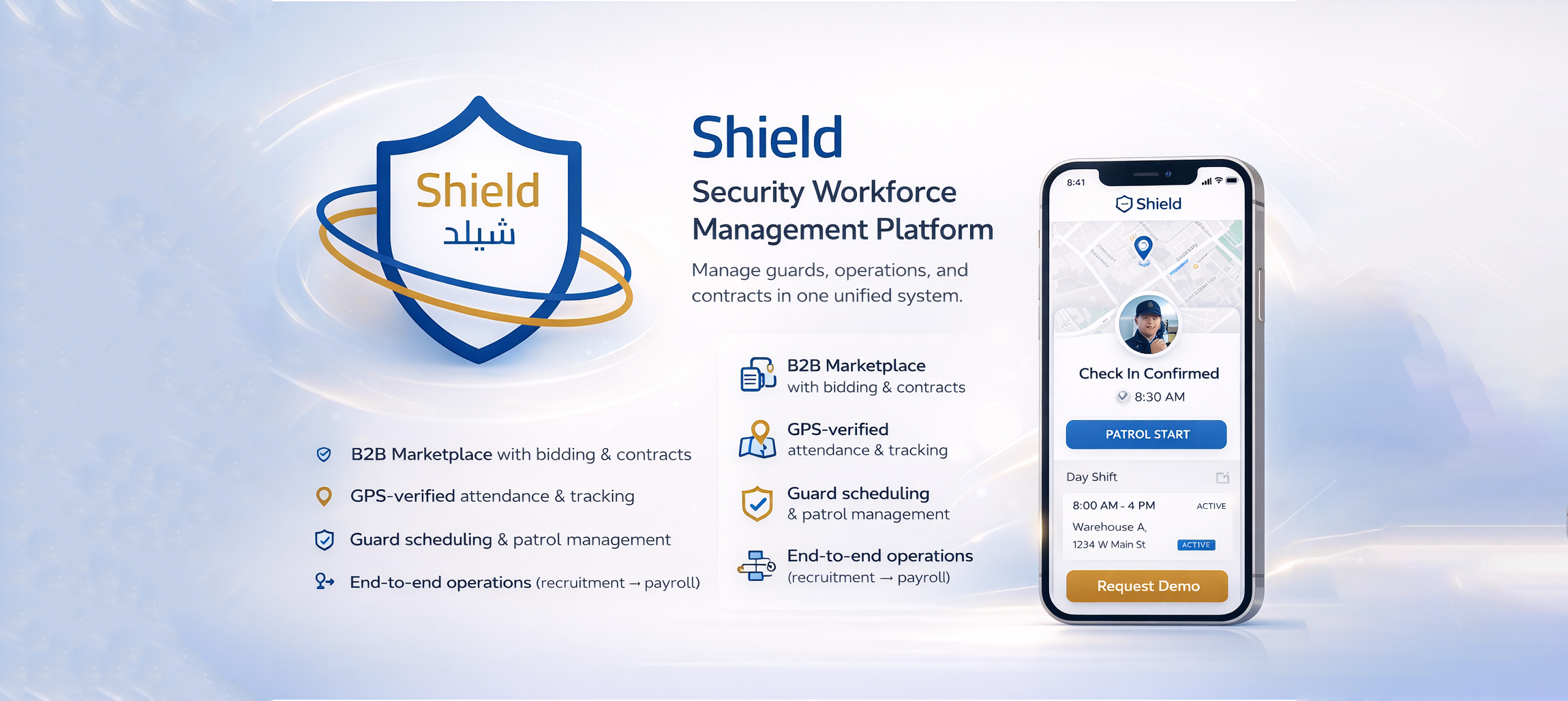
Shield - Security Workforce Management Platform
Multi-tenant workforce platform with 394 API endpoints, 321 permissions, 94 entities, 59 notification types, GPS geofencing, SOS emergency system, and push-to-talk for the security industry
Security companies in the region were managing guard operations with paper logbooks, WhatsApp groups, and Excel spreadsheets.
A company with 200 guards had no way to know in real time who was on site, who was late, or who left their geofenced zone.
Facilities paying $50,000+ per month for guard services had zero proof that guards were actually at their posts.
Payroll was calculated manually from handwritten timesheets, and every pay cycle ended in disputes over overtime hours.
Recruiting a new guard meant paper applications, lost resumes, and no structured onboarding.
Contract negotiation between facilities and security companies happened over email with no version control, no digital signatures, and no audit trail.
When an emergency happened at 2 AM, the escalation chain was a phone tree that failed half the time.
Patrol checkpoints were verified by paper signatures that anyone could fake.
Leave requests went through WhatsApp and got lost.
There was no way to evaluate guard performance, track violations, or generate compliance reports.
The entire industry was running on trust instead of data.
Project screenshots
We built a multi-sided marketplace on 94 entities with 394 API endpoints.
Four user types operate the platform: facilities post service ads and price requests, security companies bid with detailed cost breakdowns, guards manage their work from a mobile app, and admins oversee everything.
The marketplace supports ads with competing offers, direct price requests with negotiation chat, and contract generation with dynamic fields, custom clauses, payment schedules, and signatures from both parties.
Guards clock in with GPS geofencing that tracks their position against configurable zones (100m default, 80m warning, with automatic clock-out after 30 minutes outside the zone).
Patrol routes have checkpoints that guards complete with GPS verification.
The SOS emergency system broadcasts alerts to location groups via SignalR with live GPS tracking throughout the incident.
Push-to-talk runs through SignalR hubs where guards request and release transmission channels.
Payroll calculates automatically from attendance data with daily hour thresholds, overtime multipliers, bonuses, and deductions.
The recruitment pipeline covers job posting, applications, interview scheduling, and onboarding task management.
Leave requests have a full approval workflow.
59 notification event types cover everything from shift reminders to geofence violations to emergency escalations, delivered through Firebase FCM and SignalR.
321 permissions across 5 role types (main, company, facility, guard, preventive security) control access to every operation.
The Flutter mobile app has 28 screens covering attendance, patrols, tasks, emergencies, leave, channels, chat, shifts, and settings.
Everything runs in Arabic and English.
Results
394 API endpoints across 94 database entities with multi-tenant data isolation
321 granular permissions across 5 role types: main admin, company, facility, guard, and preventive security
GPS geofencing with configurable zones (100m default, 80m warning, auto clock-out after 30min violation)
SOS emergency system with real-time GPS tracking, location broadcasting via SignalR, and 7 escalation event types
Push-to-talk via SignalR with channel-based transmission request and release workflow
Dynamic contract generation with custom fields, clauses, payment schedules, and signatures from both parties
Payroll engine with daily hour thresholds, overtime multipliers, bonuses, deductions, and pay cycle processing
Full recruitment pipeline: job posting, applications, interview scheduling, and onboarding task management
59 notification event types covering shifts, attendance, geofencing, emergencies, patrols, violations, and leave
B2B marketplace with service ads, competing bids, price requests, negotiation chat, and cost breakdowns
28-screen Flutter mobile app with biometric login, patrol checkpoints, attendance, tasks, and offline support
3 SignalR hubs for real-time position tracking, push-to-talk, emergency alerts, and notification delivery
Technology Stack
Want to help build the next one? See open engineering, design, and sales roles →